-
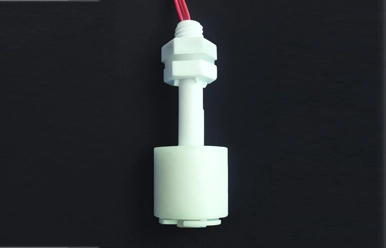
A reed switch level sensor is a liquid level detection device that uses a magnetic float and a reed switch to identify whether liquid has reached a certain point in a tank or container. As the float moves with the liquid surface, its built-in magnet activates the reed switch inside the sensor stem or housing. The result is a simple electrical signal used for alarms, pump control, heater protection, or equipment safety.
Although many modern sensing technologies are available, reed switch level sensors remain widely used because they are simple, compact, low-power, and reliable. For applications that only require point-level detection, a reed switch design can often be more practical than complex continuous measurement systems.
The core component of the sensor is the reed switch. A reed switch contains two ferromagnetic contact blades sealed inside a glass capsule. When a magnet approaches, the magnetic field causes the contacts to open or close. When the magnet moves away, the contacts return to their original state.
In a liquid level sensor, the magnet is usually located in the float. As the liquid rises or falls, the float moves. When it reaches the switching position, the reed switch changes state and sends a signal.
This design has several advantages:
The electrical contacts are sealed away from the liquid.
The float movement is simple and easy to understand.
The sensor can work without continuous power consumption in many switching designs.
The output signal is easy to connect to controllers, relays, or alarms.
The structure is suitable for compact tanks and OEM equipment.
A reed switch level sensor is suitable for many applications where reliable high-level, low-level, or liquid presence detection is needed.
| Industry | Typical Application |
| Home appliances | Water tanks, coffee machines, humidifiers, water heaters |
| HVAC systems | Condensate pans, reservoirs, pump protection |
| Automotive | Coolant tanks, washer fluid tanks, fuel level warning |
| Industrial equipment | Oil reservoirs, coolant tanks, hydraulic systems |
| Water treatment | Storage tanks, filter systems, pump control |
| Safety systems | Overflow protection and dry-run prevention |
For OEM products, reed switch level sensors are commonly selected because they are easy to integrate and do not require complex signal processing. The control circuit only needs to read an on/off signal.
Different level sensing technologies serve different purposes. A reed switch level sensor is not designed to replace every level measurement method. Instead, it is ideal for simple and stable point-level control.
| Sensor Type | Best For | Typical Output |
| Reed switch level sensor | High/low point detection | On/off signal |
| Continuous level sensor | Real-time level measurement | 4-20mA, voltage, digital signal |
| Capacitive level sensor | Non-contact or through-wall detection | Switching or analog output |
| Ultrasonic level sensor | Non-contact tank measurement | Analog or digital output |
| Optical level sensor | Small containers and transparent liquids | Switching output |
If the system needs to know the exact liquid height or volume at all times, a continuous level sensor may be better. If the system only needs to detect whether liquid is present at a specific level, a reed switch level sensor is often simpler and more cost-effective.
The sensor material must be compatible with the liquid. Water, oil, coolant, detergent, and chemical solutions can have very different effects on plastic and metal materials. The float must maintain buoyancy and move smoothly.
Reed switch level sensors can be designed as vertical or horizontal types. Vertical sensors are often installed from the top or bottom of the tank. Horizontal sensors are installed from the side. The correct choice depends on tank access, available space, and detection point.
Normally open and normally closed configurations are both common. The right choice depends on the control circuit and safety logic. Some applications may require SPDT output for more flexible control.
The voltage, current, and power rating must match the connected circuit. A sensor connected to a PLC input has different requirements from one used with a relay or direct load.
Temperature, vibration, moisture, dust, pressure, and installation angle can all affect sensor performance. For harsh environments, a more durable housing or stainless steel structure may be required.
Reed sensors are not only used in level switches. They are also used for proximity detection, position sensing, door status detection, safety interlocks, motion detection, and flow monitoring. This makes reed technology highly flexible for OEM equipment design.
For liquid level applications, reed switch technology offers a balance of reliability and simplicity. It does not require complicated calibration and can provide long-term switching performance when correctly selected.
BST Sensor provides multiple reed sensor categories, including rectangular reed sensors, cylindrical reed sensors, metal reed sensors, and SMD reed sensors. These options allow engineers to select or customize the right magnetic sensing structure for different equipment designs.
When comparing reed sensor suppliers, buyers should look beyond standard models. A good supplier should understand sensor structure, magnet selection, cable design, housing materials, electrical ratings, and application conditions.
For OEM projects, important supplier capabilities include:
Support for custom housing dimensions
Cable length and connector customization
Selection of NO, NC, or changeover contact forms
Material recommendations based on liquid compatibility
Prototype testing and sample validation
Stable production quality for batch orders
BST Sensor supports reed sensor and level sensor customization for different industries, including home appliances, industrial automation, automotive, HVAC, security, and test equipment.
A reed switch level sensor remains a reliable solution for liquid level control because it is simple, compact, and easy to integrate. It is especially suitable for high-level alarms, low-level protection, liquid presence detection, and OEM tank designs.
For buyers looking for reed sensor suppliers or customized reed switch level sensor solutions, BST Sensor can provide support in sensor structure, float material, switch logic, cable design, and application-specific customization.
 Related BST Position Sensors