-

A continuous level sensor is a device that measures liquid level across a range and provides a real-time output signal. Instead of only telling the system whether liquid is above or below one point, it continuously reports the level position inside the tank.
This makes continuous level sensing useful when the control system needs more detailed information, such as tank percentage, liquid height, volume estimate, or gradual level change. Depending on the design, the output may be analog, such as 4-20mA or 0-5V, or digital, depending on the control system requirements.
BST Sensor provides customized continuous level sensor solutions for applications that require sensing length, mounting style, output type, housing material, and signal configuration based on the actual tank structure.
A point level switch detects whether liquid has reached a specific level. It does not measure the full range of liquid height. Instead, it provides a simple on/off signal when the liquid reaches a preset point.
Common point-level devices include:
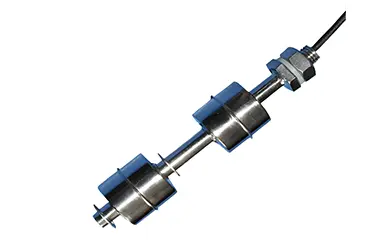
Vertical liquid level switches
Horizontal liquid level switches
Reed switch level sensors
Magnetic float switches
High-level alarm switches
Low-level pump protection switches
Point level switches are widely used because they are simple, cost-effective, and easy to connect to control systems.
The best choice depends on what information your system actually needs.
| Requirement | Continuous Level Sensor | Point Level Switch |
| Real-time tank level measurement | Yes | No |
| High-level alarm | Yes, with controller logic | Yes |
| Low-level pump protection | Yes, with controller logic | Yes |
| Exact level percentage | Yes | No |
| Simple on/off output | Not the main purpose | Yes |
| Cost-sensitive design | Usually higher | Usually lower |
| Process monitoring | Stronger | Limited |
| OEM appliance tank detection | Sometimes | Often suitable |
| Industrial inventory control | Suitable | Limited |
If the system only needs overflow protection or empty-tank warning, a point level switch is often enough. If the system must monitor changing liquid level throughout the tank, a continuous level sensor is the better choice.
A continuous level transducer is suitable when the tank level must be measured and transmitted as a changing signal. This is common in applications where operators or controllers need more than a simple alarm.
Typical applications include:
| Application | Why Continuous Measurement Helps |
| Industrial tanks | Tracks level changes during production |
| Chemical storage | Helps manage liquid volume and refilling |
| Water treatment | Supports automated level control |
| Fuel and oil reservoirs | Provides more accurate level visibility |
| Test and measurement equipment | Delivers level data for monitoring |
| OEM systems with smart controls | Enables digital display or system feedback |
For example, if a tank must maintain liquid between 30% and 80%, a continuous signal allows the controller to respond more precisely. If the system only needs to stop a pump when liquid is too low, a point level switch may be enough.
Continuous level sensors provide more information to the control system. This can improve process stability, maintenance planning, and system automation.
Key advantages include:
Real-time liquid level feedback
Better visibility of tank conditions
Support for analog or digital control systems
Useful for smart equipment and display panels
More flexible control logic
Suitable for inventory and process monitoring
For industrial and OEM applications, continuous level data can reduce guesswork. Operators can see trends, identify abnormal consumption, and plan refilling more efficiently.
Point level switches remain important because many systems do not need full-range measurement. A simple alarm or interlock is often enough.
Key advantages include:
Simple structure
Easy installation
Lower system complexity
Clear on/off signal
Good for high-level and low-level alarms
Practical for pump protection
Suitable for compact tanks
Horizontal and vertical float switches are common examples. They can be installed at the required level and connected directly to a controller or alarm circuit.
Before selecting a sensor, define the control purpose clearly.
Choose a continuous level sensor if:
You need real-time liquid level data.
The system displays tank percentage.
The controller must adjust operation based on changing level.
The tank is part of a process monitoring system.
You need analog or digital output.
Choose a point level switch if:
You only need high-level or low-level detection.
The system requires a simple alarm.
Pump dry-run protection is the main goal.
The tank is small or cost-sensitive.
The control system only accepts on/off input.
In many systems, both technologies can be used together. A continuous level sensor may provide real-time monitoring, while separate point level switches provide independent safety alarms.
Whether selecting a continuous level sensor or a point level switch, buyers should confirm the following details:
| Factor | Why It Matters |
| Tank height | Determines sensing length or switch position |
| Liquid type | Affects float and housing material selection |
| Temperature | Impacts sensor material and sealing design |
| Pressure | Important for closed tanks and industrial systems |
| Output signal | Must match PLC, display, or control board |
| Mounting method | Top, bottom, or side installation |
| Cable and connector | Important for OEM assembly |
| Required accuracy | Determines whether point or continuous sensing is enough |
For customized projects, providing a tank drawing, liquid details, operating temperature, installation position, and control circuit information helps the supplier recommend the right sensor.
BST Sensor supports liquid level sensing solutions including horizontal liquid level sensors, vertical liquid level sensors, multi-level sensors, magnetic floats, and continuous level sensors. This allows buyers to compare different technologies based on the actual application rather than forcing one sensor type into every project.
For OEM and industrial customers, BST Sensor can help customize sensing length, material, switch logic, output type, cable length, connector, and mounting structure.
A continuous level sensor is the right choice when real-time tank level data, analog output, or process visibility is required. A point level switch is better when the system only needs a simple high-level or low-level signal.
For buyers comparing a continuous level transducer, vertical level switch, horizontal level switch, or reed switch level sensor, BST Sensor can provide customized support based on tank structure, liquid type, electrical requirements, and control logic.
 Related BST Position Sensors