-
Hall effect switches and reed switches both detect magnetic fields, but they work in very different ways. A Hall effect switch is a solid-state electronic sensor, while a reed switch uses two metal contacts sealed in a glass tube.
A Hall effect switch is a magnetic sensor that changes its output when it detects a magnetic field. Because it is solid-state, it has no moving parts, which usually makes it more durable over time. It also needs power to operate, so it is better suited for systems that already have an electrical supply.
Hall effect switches are often used in applications that need fast response, long life, and reliable performance in repeated cycles. They are common in industrial equipment, automotive systems, and embedded electronics.
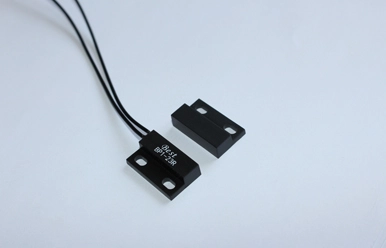
A reed switch is a simple magnetic switch made of two flexible metal reeds inside a sealed glass capsule. When a magnet comes close, the reeds move and make contact, closing the circuit. When the magnet moves away, the reeds separate again.
Reed switches are popular because they are simple, inexpensive, and do not require continuous power. That makes them useful in battery-powered devices, alarm sensors, and basic position detection.
Here is a clear side-by-side view of the most important differences.
| Feature | Hall Effect Switch | Reed Switch |
|---|---|---|
| Operating principle | Detects magnetic field electronically | Uses physical metal contacts |
| Moving parts | None | Yes, mechanical reeds |
| Power requirement | Needs power | No continuous power needed |
| Durability | High | Lower due to mechanical wear |
| Contact bounce | No | Possible |
| Speed | Generally faster | Slower than Hall in many cases |
| Magnetic polarity detection | Can detect polarity in many designs | Usually does not |
| Best for | High-cycle, long-life applications | Low-power, simple switching |
Hall effect switches are generally better when durability and precision matter. Reed switches are better when simplicity and very low power consumption matter more.
Hall effect switches offer several strengths. They have no physical contact wear, so they typically last longer in applications with frequent switching. They also work well in sealed environments because they are not affected by contact oxidation in the same way as mechanical switches.
Another advantage is that many Hall effect sensors can provide more advanced sensing behavior, including polarity detection and cleaner switching signals. That makes them a strong fit for modern electronic systems.
Reed switches are valued for their low cost and very low power use. Since they do not need to stay powered to maintain their open or closed state, they are especially useful in battery-operated products.
They are also easy to understand and easy to implement in basic circuits. For simple door sensors or basic magnetic on/off detection, a reed switch can be the most practical choice.
Choose a Hall effect switch if you need:
Long service life.
High switching frequency.
Better resistance to mechanical wear.
More advanced sensing capabilities.
Cleaner integration with electronic systems.
Choose a reed switch if you need:
A low-cost solution.
Zero or near-zero standby power.
A simple on/off magnetic switch.
A straightforward design for alarms or battery-powered devices.
In short, Hall effect switches are usually the better option for modern, high-cycle electronic designs, while reed switches remain a strong choice for simple and low-power applications.
One common mistake is choosing a reed switch for a high-cycle application without considering mechanical wear. Another is assuming that all Hall effect switches are the same, when output type and polarity behavior can vary by design.
It is also important to consider magnet alignment, switching distance, and the actual power budget of the device. These factors often matter as much as the switch type itself.
Not always. A Hall effect switch is better for durability, frequent switching, and advanced sensing, while a reed switch is better for simplicity and low power.
A reed switch does not need continuous power to operate, which is one of its main advantages in battery-powered systems.
No. Hall effect switches are solid-state devices and do not use mechanical contacts.
Hall effect switches generally last longer because they do not rely on physical contact movement.
Both can work, but reed switches are common in simple door alarms, while Hall effect switches are often chosen when longer life or more robust performance is needed.
Hall effect switches and reed switches solve the same basic problem in different ways. If you want durability, speed, and better electronic integration, Hall effect is usually the stronger choice. If you want simplicity, low cost, and minimal power use, a reed switch is often enough.
 Related BST Position Sensors